
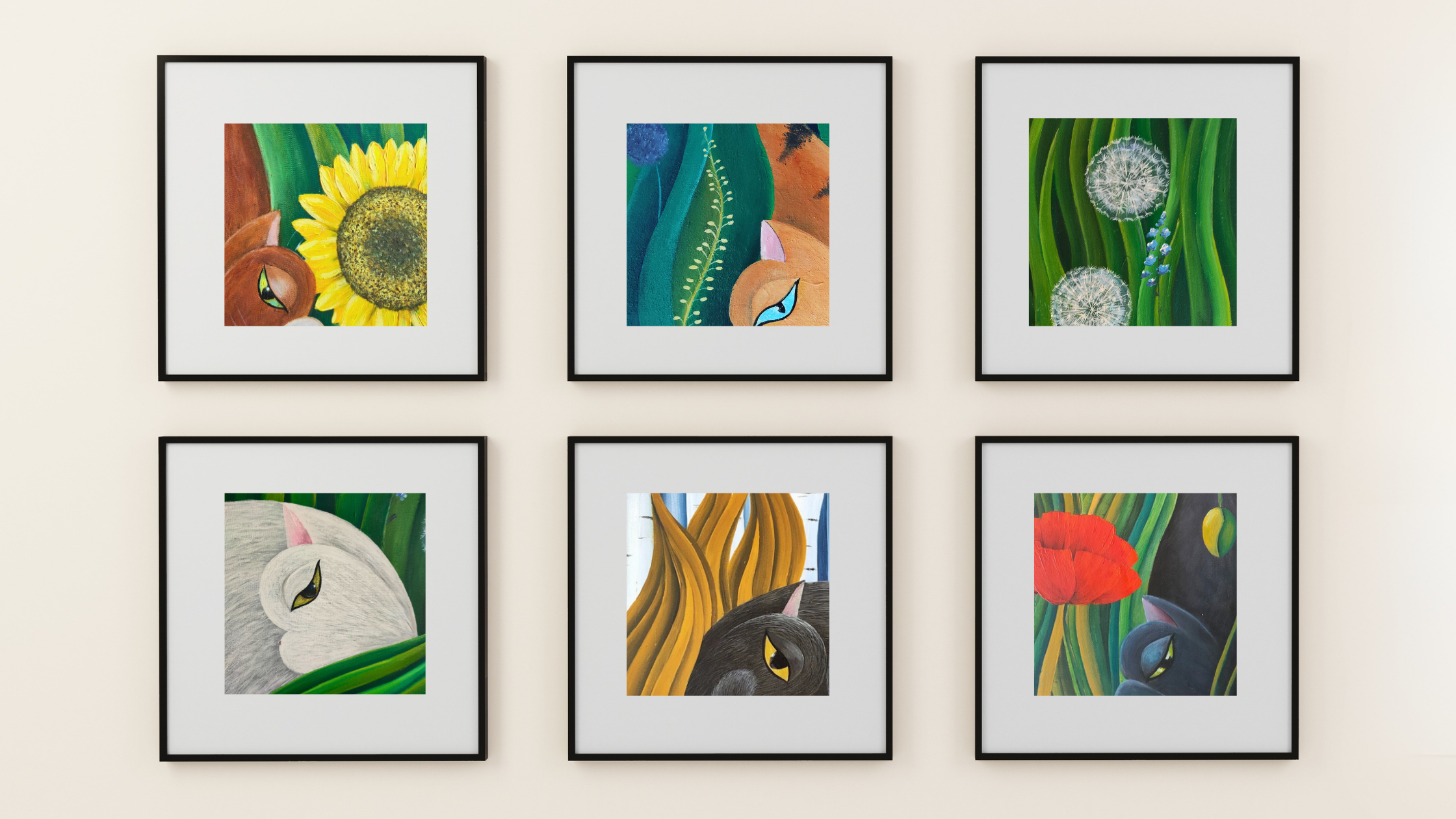
When people see a finished cat painting, they usually notice the obvious things first: the eyes, the posture, the colours, the little details that make the cat feel present. What they don’t always see is what I’m actually trying to paint underneath all of that.
For me, the real goal isn’t to copy a photo or prove I can paint fur. The goal is to translate a feeling into paint.
I start with the feeling, not the reference
A reference photo can be a helpful starting point, but it’s never the whole story. Before I think about details, I ask myself a simple question: what do I want the viewer to see and feel when they look at this painting?
Do I want it to feel calm and safe, like a cat curled up in a quiet corner? Do I want it to feel watchful and mysterious, like a cat half-hidden in tall grass? Do I want it to feel playful, bold, or slightly surreal?
Once I know the feeling, the rest of the decisions start to make sense. Composition, colour, and even brushwork become ways of guiding the viewer toward that emotional experience.
Composition is how I guide your attention
When I build a composition, I’m thinking about the viewer’s eye like it’s moving through the painting in real time. I want to decide what you notice first, what you discover second, and where your attention rests.
That’s why I often simplify or exaggerate certain elements. I might:
- Push the cat’s face into clearer focus and let other areas soften
- Use surrounding shapes (like grass, stems, or flowers) to frame the cat
- Create gentle “paths” for the eye using repeated lines or curves
I don’t want the composition to feel like a diagram. I want it to feel natural—like you’re being quietly led, not instructed.
Paint is my language for mood
There’s something about paint—especially acrylics—that feels perfect for this kind of storytelling. It can be crisp or soft, layered or bold, controlled or expressive. And those choices matter.
If I want a painting to feel peaceful, I’ll often use smoother transitions and calmer shapes. If I want it to feel energetic or slightly wild, I’ll let the brushwork show more. I’ll build texture, let colours collide, or create sharper contrasts.
Paint gives me a way to show emotion without spelling it out.
Colour palettes: I borrow them from the seasons
One of my favourite parts of the process is choosing the palette, and I rarely choose colours in isolation. I’m constantly paying attention to seasonal changes in the world around me.
Seasonal colour isn’t just “pretty”—it carries mood.
In my mind:
- Spring palettes feel fresh, light, and hopeful
- Summer palettes feel bold, saturated, and alive
- Autumn palettes feel warm, earthy, and nostalgic
- Winter palettes feel quiet, cool, and a little mysterious
Even if the painting isn’t literally set in a specific season, I like letting seasonal colour guide the emotional tone. It helps the painting feel grounded, like it belongs to a real atmosphere.

A peek into a cat’s summer afternoon. ‘Sunlight Sanctuary’ celebrates those quiet moments when nature and curiosity create perfect harmony. A glimpse into my process. 
Crafting Golden Petals: The Details That Make Sunflowers Shine 
The Final Touch: Perfecting Nature’s Pattern 
The Poetry of Petals: Texture in Acrylic 
Final Flourishes: The Art of Completion
The cat is the subject, but the environment is the story
I love painting cats because they’re expressive without trying. They can look serene, suspicious, curious, unimpressed—sometimes all at once.
But what makes a cat painting feel complete to me is the world around the cat. The environment is where I can add symbolism, rhythm, and movement. It’s where I can support the feeling I chose at the beginning.
Sometimes that means tall grass arranged like waves, so the cat can hide and observe. Sometimes it means flowers placed like signposts to guide the eye. Sometimes it’s just a quiet background that lets the cat’s expression do all the talking.
When I know it’s working
There’s a moment in the process where the painting stops feeling like “a picture of a cat” and starts feeling like a presence. The eyes begin to hold the space. The colours start to hum together. The composition feels balanced without being stiff.
That’s when I know I’m close.
And even then, I’m still asking the same question I started with: is this saying what I want it to say?
Closing: what I hope you feel
If you take anything from this, I hope it’s this: when I paint a cat, I’m not only painting an animal. I’m painting a mood. A moment. A quiet kind of connection.
I want you to feel something when you look at it—calm, comfort, curiosity, softness, or even that familiar sense that the cat knows something you don’t.
If you’ve ever connected with a painting like that, I’d love to know: what do you notice first in a cat painting—colour, expression, or the atmosphere around it?
- AI and Social Media
- Behind-the-scenes of Artwork Creation
- Events
- Seasonal Reflections
- Thoughts on Creativity


Leave a Reply